
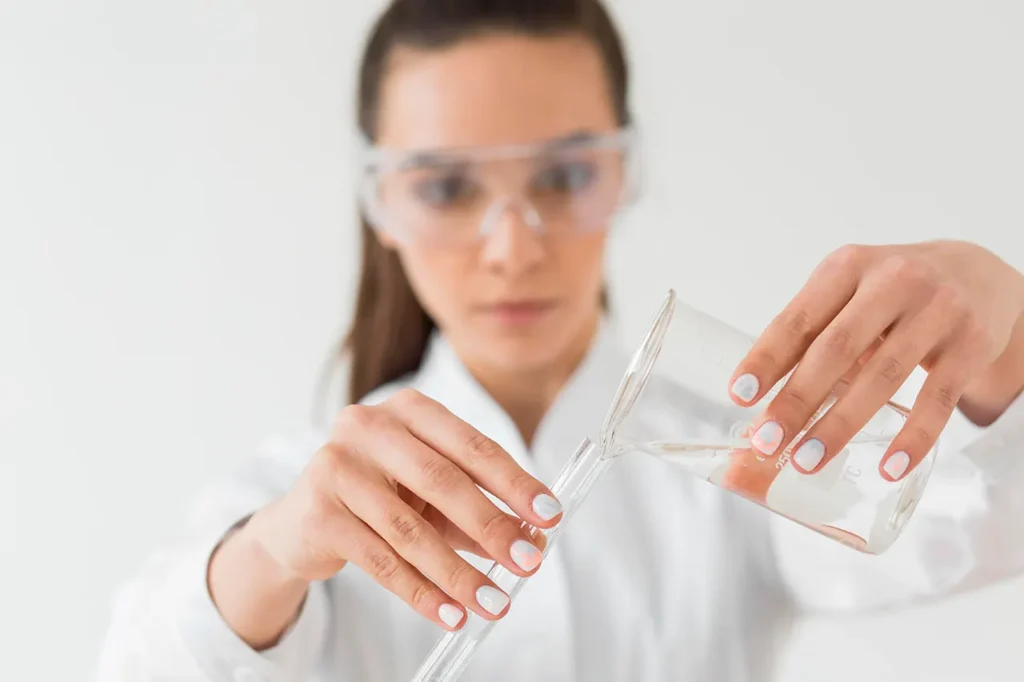
In a scientific laboratory, accuracy is the key to reliable results. However, many may overlook one of the most fundamental factors directly affecting that accuracy: the cleanliness of glassware. Even small residues of dirt or chemicals can cause unwanted reactions, alter pH values, or inhibit microbial growth, which may lead to misinterpretation of experimental results and wasted time.
Cleaning glassware is therefore not just about making it "look clean," but a scientific process that requires attention to every step. This article is a complete guide that will introduce techniques and procedures for cleaning glassware to be crystal clear and free from contamination, so you can be confident in every experiment.
Imagine you're preparing a buffer solution, but there are still small residues of acid or base in the beaker. The result is that the pH of your prepared buffer will deviate from what it should be. Or, in cell biology, residual dish soap might be toxic to the cells you are culturing. Therefore, investing time in correctly cleaning glassware is an investment in the accuracy of your data and your research results.
For the best results, you should strictly follow these steps:
1. Preliminary Rinse As soon as you're done using the glassware, immediately empty the solution and rinse it with tap water to remove most of the residue before it dries and hardens on the container. If there are solid residues, gently scrub them off with an appropriate glassware brush. Doing this step will significantly simplify the subsequent cleaning process.
2. Washing with Detergent You should choose a laboratory-grade detergent specifically made for glassware, as general dish soap often contains fragrances and other ingredients that can leave a film on the glass surface. Use a brush to thoroughly scrub every nook and cranny of the glassware, both inside and out.
3. Rinsing with Tap Water After scrubbing with detergent, rinse thoroughly with running tap water to remove all suds and cleaning solution. Rinse repeatedly (at least 3-5 times) until you're certain no slippery residue from the detergent remains on the glass surface.
4. Final Rinse with Distilled/DI Water This is the most crucial "secret" step to prevent water spots after drying. Tap water contains dissolved minerals and various ions, which, upon evaporation, will leave white stains on the glass surface. Rinsing 2-3 final times with distilled water or deionized water (DI water) will wash away these minerals, leaving your glassware crystal clear and free of any stains.
5. Drying The best method is to invert the glassware on a drying rack specifically designed for glassware and allow it to air dry in a dust-free area. If urgent use is necessary, it can be placed in an oven at a moderate temperature. A caution is Do not never use cloth or paper to wipe the inside of glassware, as they can leave tiny fibers that will become contaminants in your next experiment.
Summary
Properly cleaning glassware is always an investment in the accuracy of your experiments, an investment you'll always get back. Paying attention to these small details can make a huge difference in scientific results. And the best start is choosing high-quality glassware that's durable and easy to clean. At MIT Trade we offer a wide variety of glassware and plasticware for laboratories, along with expert consultation to help you select the right equipment for your specific needs.
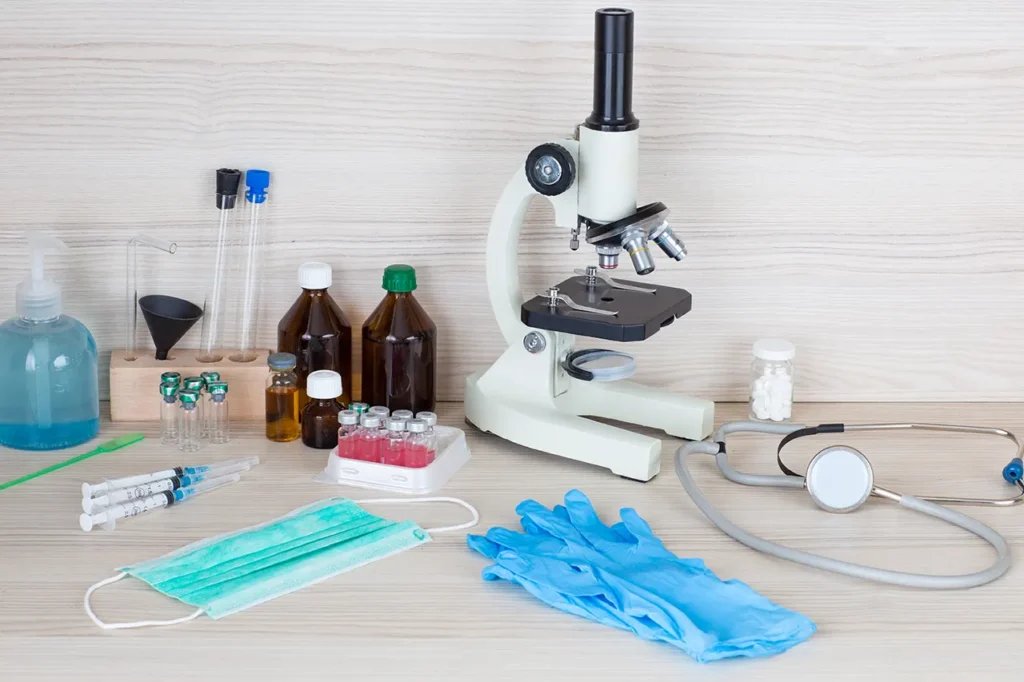
Working in a scientific laboratory—whether for teaching, research, or quality control in industrial factories—requires appropriate tools and equipment to ensure experiments run smoothly, accurately, and safely. For those who are setting up a new lab or students just stepping into the world of experimentation, it can be confusing to know where to start.
Today, we've compiled a list of 10 "basic science equipment" that are truly the heart and soul of almost every laboratory. Let's take a look at what they are and the crucial functions each piece performs.
1. Beaker A beaker is a cylindrical glass container with a wide mouth, approximate volume markings, and a spout for easy pouring. It is one of the most versatile pieces of equipment, used for holding chemicals, mixing solutions, heating substances, and even temporarily collecting waste liquids.
2. Graduated Cylinder When you need to measure liquid volume more accurately than with a beaker, the graduated cylinder is the answer. Its tall cylindrical shape and precise volume markings allow for accurate reading of liquid levels. It is an essential tool for preparing solutions with exact concentrations.
3. Volumetric Flask For tasks requiring the highest accuracy in preparing standard solutions, the volumetric flask is indispensable. It is a long-necked glass bottle with a single precise volume mark on the neck, designed to hold an exact volume of liquid at a specified temperature.
4. Pipette A **pipette** is a device used for precisely measuring and transferring small, accurate volumes of liquids. They come in various forms, including **glass pipettes** (like volumetric and measuring pipettes) and **adjustable volume pipettes** (like micropipettes). Pipettes are essential for tasks requiring the handling of small sample quantities.
5. Stirring Rod A stirring rod is a simple yet frequently used piece of equipment, typically made from chemical-resistant glass. It's used for mixing solutions to ensure even distribution, speeding up the dissolution of solids, or guiding liquids when pouring from one container to another to prevent spills or splashing.
6. Digital Balance For most chemical experiments, measuring the mass of substances is crucial, making the **digital balance** an absolutely essential scientific instrument. It can weigh substances quickly and accurately, and is available in various levels of precision, ranging from two decimal places up to four or five decimal places for analytical work requiring high accuracy.
7. Microscope In biology or medical laboratories, the **microscope** is a window into the world invisible to the naked eye. It is used to view and study microorganisms such as cells, bacteria, or various tissue structures. It is a fundamental tool that vastly expands the horizons of learning.
8. Stand and Clamp These pieces of equipment act as a "third hand" in the lab. They're used for holding glassware or other apparatus firmly in the desired position, such as setting up distillation apparatus or securing a burette during titration. This makes experiments more convenient and safer.
9. Alcohol Burner It's a basic, safe, and easily controllable heat source. It's used for heating solutions that don't require very high temperatures for boiling, or for sterilizing certain equipment, such as inoculation loops.
10. Personal Protective Equipment (PPE) Safety always comes first. The basic PPE that every lab must have includes **safety goggles** to protect eyes from chemical splashes, a **lab coat** to protect skin and clothing, and **rubber gloves** to prevent direct contact with chemicals.
This is just a part of the essential basic science equipment. Having these tools complete and in good condition will help your laboratory work proceed efficiently and safely. If you are looking for high-quality equipment for your lab, at
MIT Trade We provide sales and import services for all types of scientific equipment, instruments, and chemicals. We are ready to provide expert consultation to meet all your needs. Contact us today!
The website mit-trade.com uses cookies or other similar technologies on our site. Please review our Cookie Policy and Data Privacy Policy before using the website at the links below.